Horizon Autherium Dragon RGB Gaming PC Review (2026): Core i9 5.4GHz, RTX 5070 OC, 64GB RAM
The Dragon Has Landed: Horizon Autherium Dragon RGB i9 & RTX 5070 OC Review
This post contains affiliate links. #CommissionsEarned
There are two ways to buy a gaming PC. The safe way: a big-brand tower with conservative specs and a beige personality. And the boutique way: a builder who stuffs the case with everything the platform can hold, overclocks it at the factory, cools it with liquid, and lights it up like a festival. The Horizon Autherium Dragon is unapologetically the second way — 64GB of RAM where the high-end standard is 32, a 5TB storage split between a 7,000MB/s NVMe and a 4TB hard drive, an unlocked Core i9 touching 5.4GHz, and a factory-overclocked RTX 5070 behind a dragon-emblazoned front panel. We spent time with what this machine actually is to answer one question: is more still more, or is it too much?
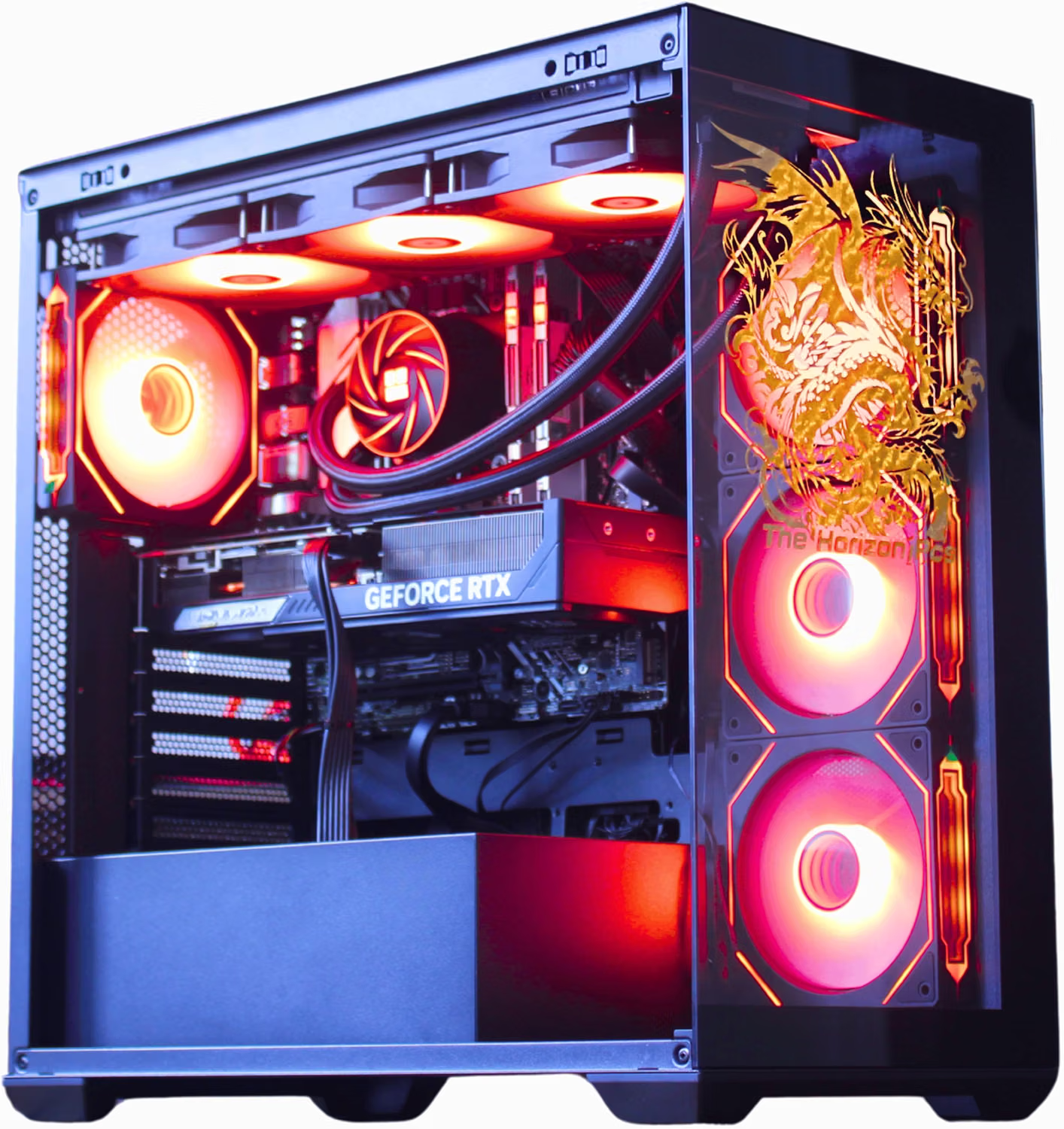
Boutique builders live and die on one promise: that someone who knows hardware picked every component on purpose. Horizon’s pitch here is a system with no obvious weak link — memory doubled beyond the usual flagship spec, storage split smartly between speed and capacity, a full 360mm liquid loop instead of a stock air cooler, and an 850W 80+ Gold power supply with six spare SATA connectors for whatever you add later.
Then there is the support layer most boutique listings bury: a 3-year parts and 5-year labor warranty, access to specialists with over twenty years of experience, and — as of August 2026 — every firmware and software component fully updated before the machine ships, with free ten-minute firmware assistance if you ever need it. The Dragon arrives ready, not almost-ready.
Silicon Foundations: Unlocked Core i9 & Factory-Overclocked RTX 5070
The processor is an unlocked Core i9 — the enthusiast-class chip, 4.8GHz at base with boosts up to 5.4GHz and 30MB of cache feeding the cores. The practical translation: this is a CPU that refuses to be the bottleneck. In gaming terms that means high-refresh play stays smooth even when a title leans on the processor; in real-world terms it means streaming while gaming, exporting video while a download finishes, or juggling a browser battlefield of tabs simply does not phase it. The unlocked badge matters less for manual tinkering and more for what it signals — this is silicon chosen for headroom, running inside a system designed to let it breathe.
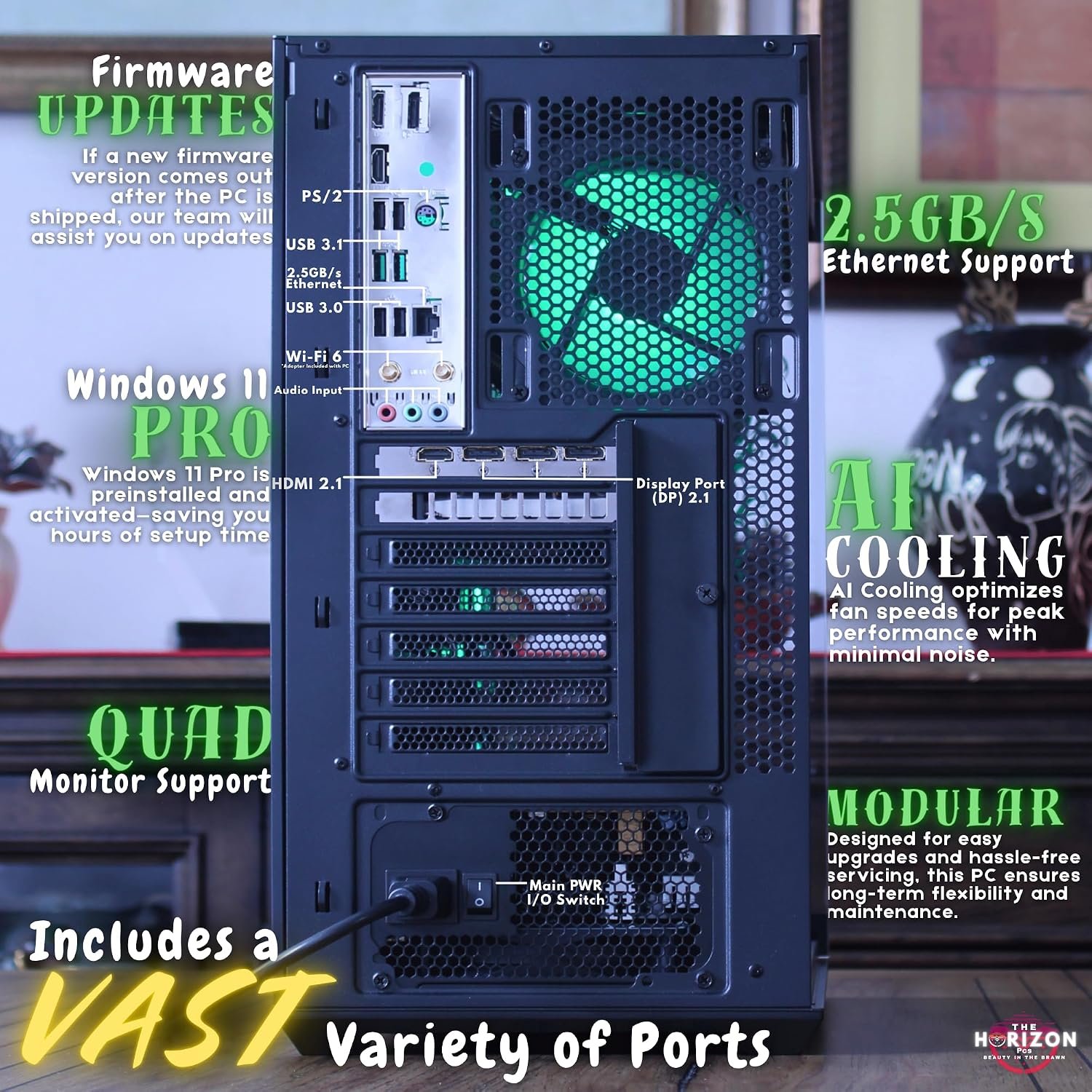
Graphics are the other half of the story: an NVIDIA GeForce RTX 5070 OC with 12GB of VRAM, overclocked at the factory for higher and more consistent frame rates. A factory overclock is the sensible version of the tradition — you get the extra performance without the instability risks of pushing a card yourself, and the builder stands behind the result under warranty. The card brings the current-generation feature set: real-time ray tracing for realistic lighting and reflections, DLSS 4 support for smooth performance at higher resolutions, improved efficiency and lower power draw, and a quad-display output arrangement (one HDMI, three DisplayPort) that handles a multi-monitor battlestation without adapters. It is also flagged VR and AI deep-learning ready — relevant if a headset is in your future or you experiment with local AI tools.
64GB of RAM
Twice the 32GB that high-end systems typically ship — enough memory that the question of “too many tabs” stops existing, and streaming, creating, and heavy multitasking stop competing for headroom.
5TB Dual Storage
A 1TB M.2 NVMe SSD rated up to 7,000MB/s for the OS and live games, plus a 4TB 7200RPM hard drive for the library — with extra M.2 and HDD ports open for future expansion.
360mm AIO Liquid Cooling
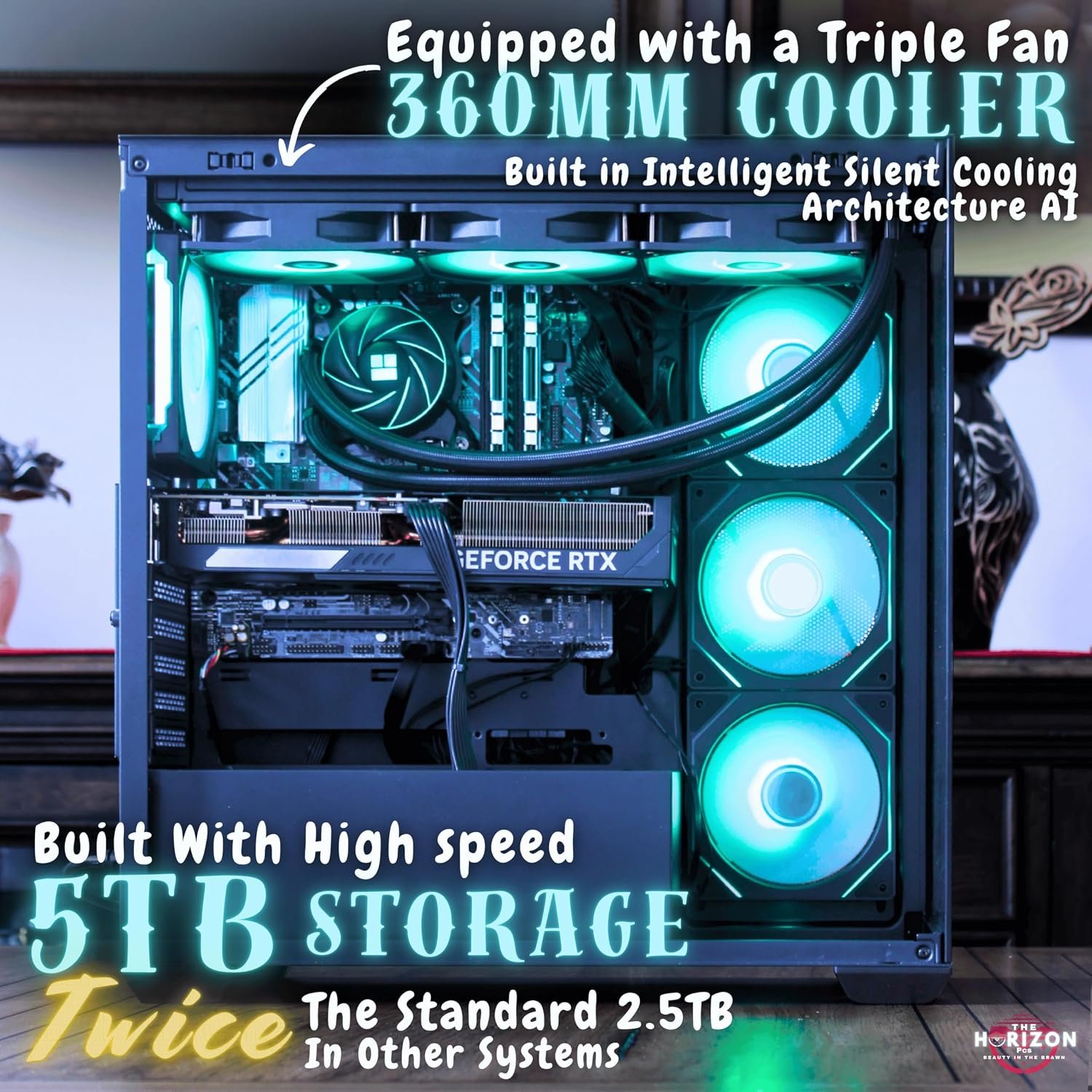
A full 360mm liquid loop with intelligently controlled fan speeds — the kind of cooling that keeps an unlocked i9 at boost clocks through marathon sessions without sounding like one.
Cooling: The Eleven-Fan Airflow Story
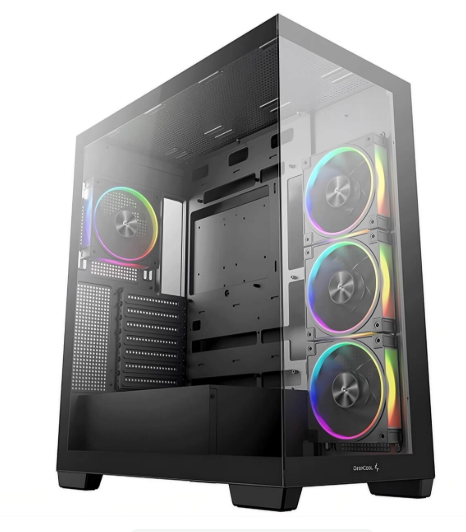
Here is where boutique builds separate from the crowd, and the Dragon makes its most concrete argument. Cooling is not one component here — it is a system: a 360mm all-in-one liquid cooler on the CPU, and a total of eleven fans across the build (three on the GPU itself, one in the power supply, and eight dedicated to overall temperature control). Why does this matter more than it sounds? Because heat is the silent tax on performance: a hot chip throttles, a throttled chip drops frames, and most prebuilts quietly run their components at the thermal edge to save cost. This machine’s approach is the opposite — so much airflow, arranged so deliberately, that sustained boost clocks become the norm rather than the burst. And because fan speeds are intelligently controlled, all of that cooling does not arrive with a jet-engine soundtrack: Horizon tunes the fleet for whisper-quiet performance under normal loads.
Memory & Storage: Why 64GB and 5TB Is the Right Kind of Excess
Start with the memory, because it is the headline doubling: 64GB of RAM where the high-end average in prebuilt gaming systems is 32GB. Is 64GB necessary for gaming alone today? Not strictly. But the moment your gaming PC is also a streaming PC, a video-editing PC, or a machine that keeps a hundred Chrome tabs and a Discord and a launcher stack alive at once, memory is the first wall you hit — and this configuration simply removes that wall for the life of the machine. RAM is the cheapest future-proofing you can buy, and here it is bought in advance.
The storage split is the genuinely clever part. A 1TB M.2 NVMe SSD rated for up to 7,000MB/s carries the operating system and the games you actually play — that number is what makes boot times near-instant and level loads blink-and-miss. Beside it sits a 4TB 7200RPM hard drive: the attic. The library of installed-but-dormant games, captured footage, and archives lives there without crowding the fast lane. And when even 5TB total starts feeling snug, the chassis has an extra M.2 NVMe port and an additional HDD bay waiting — the expansion path is designed in, not improvised.
Design: Dragon Front Panel & ARGB, Done Loud
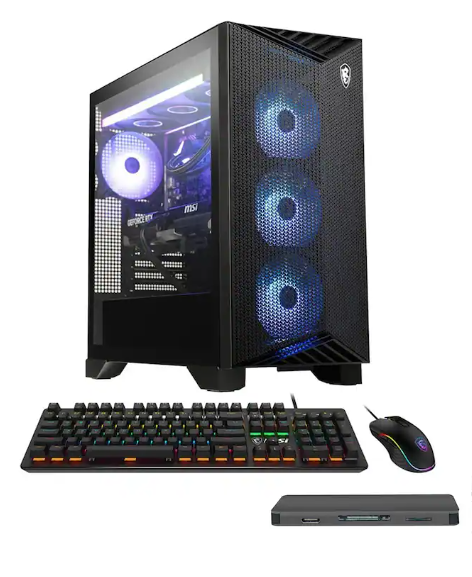
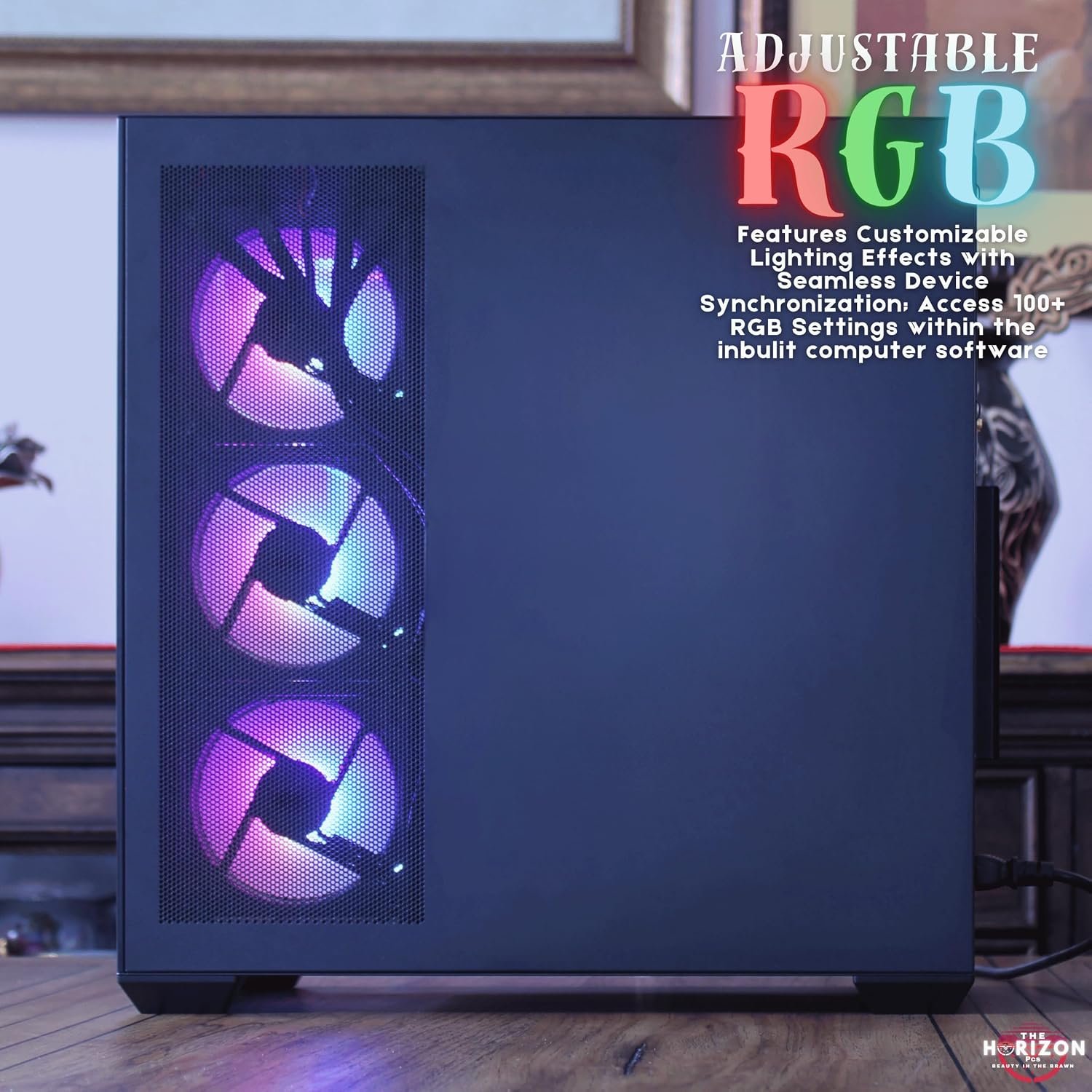
The Dragon wears its name on its face — a sculpted dragon front panel that makes the machine unmistakably a statement piece rather than a box that hides under the desk. The ARGB lighting is software-controlled with thousands of options, so the look is yours to define: a slow ambient breathing pulse for the workday, a full synchronized storm for the weekend. RGB divides opinion, but there is a real difference between bolted-on lighting and lighting designed into the chassis architecture — this is the latter, and for the buyer who wants the rig to be part of the room, it is a feature, not a flourish.
Power, Ports & Connectivity
The power supply is an 850W 80+ Gold unit — efficient, with ample headroom for the platform — and it arrives with six extra SATA connectors, which tells you the builder expects you to grow this machine over time. Connectivity runs generous: one USB-C 3.2 port, eight USB 3 ports for peripherals of every vintage, Bluetooth for wireless accessories, and a 2.5Gb/s LAN port for wired networking. Wireless is rated up to 2.4GB/s over WiFi — enough bandwidth that even wireless play stops being a compromise on a connection that supports it. Between the ports, the connectors, and the expansion bays, the message is consistent: this tower is a platform, not an appliance.
The Builder Behind the Box
A boutique purchase is really a purchase of the builder, and Horizon’s terms here are unusually confident: a 3-year warranty on parts and a 5-year warranty on labor, premium components selected for long-term reliability, thorough quality testing before every shipment, and access to a support team with over twenty years of hardware experience. The detail that stands out most: every firmware and software component is fully updated before the machine leaves the building — and if a firmware update cycle ever feels daunting, the team walks you through it in about ten minutes, free. (For calibration, firmware refreshes are only needed once every two to three years.) That level of engagement is what you are buying alongside the hardware.
Technical Specifications Matrix
| Central Processor (CPU) | Intel Core i9 unlocked — 4.8GHz base, up to 5.4GHz boost, 30MB cache |
|---|---|
| Graphics Card (GPU) | NVIDIA GeForce RTX 5070 OC, 12GB VRAM — factory overclocked |
| System Memory (RAM) | 64GB (double the typical 32GB high-end standard) |
| Storage | 5TB total — 1TB M.2 NVMe SSD (up to 7,000MB/s) + 4TB 7200RPM HDD |
| Expansion | Extra M.2 NVMe port + additional HDD port available |
| Cooling | 360mm AIO liquid cooler — 11 total fans (8 chassis, 3 GPU, 1 PSU), intelligently controlled |
| Power Supply | 850W 80+ Gold, with 6 extra SATA connectors |
| Display Outputs | 1x HDMI + 3x DisplayPort — multi-monitor and VR ready |
| Connectivity | USB-C 3.2, 8x USB 3, 2.5Gb/s LAN, WiFi up to 2.4GB/s, Bluetooth |
| Operating System | Windows 11 Pro |
| Chassis | Dragon front panel, software-controlled ARGB lighting |
| Warranty & Support | 3-year parts / 5-year labor — 20+ year specialist support team |
Who This Dragon Is Built For
The gamer who buys once. The buyer who does not want to think about upgrades in eighteen months — doubled RAM, 5TB of split storage, and an 850W foundation make this a machine built to stay current the long way.
The streamer and creator. An i9 with 64GB of RAM is precisely the combo that keeps game, encoder, chat, and browser overlays from fighting each other — the workload that exposes weaker machines mid-broadcast.
The VR and AI-curious. RTX-class ray tracing and DLSS 4 with factory-OC consistency, flagged VR and deep-learning ready — if a headset or local AI experimentation is on the roadmap, the door is already open.
The showpiece buyer. Some people want the PC to disappear; some want it to be the centerpiece of the room. With the dragon panel and a full ARGB suite under software control, this machine is unambiguously built for the second person.
Product Evaluation: Pros & Considerations
Pros
- 64GB of RAM doubles the typical high-end spec — multitasking and streaming headroom for years.
- 5TB of split storage: 7,000MB/s NVMe speed where it matters, 4TB of HDD capacity for the library.
- Factory-overclocked RTX 5070 OC 12GB — extra performance without DIY instability risks.
- 360mm liquid loop plus eleven-fan airflow: sustained boost clocks, whisper-quiet under normal loads.
- 850W 80+ Gold PSU with spare SATA connectors and open M.2/HDD bays — expansion designed in.
- 3-year parts and 5-year labor warranty from a specialist team, firmware fully updated pre-shipment.
Consider Alternatives If
- You prefer a minimalist, understated chassis — the dragon panel and ARGB suite are deliberately bold.
- Your budget targets a strictly entry-level tier — this configuration is engineered for the no-compromise bracket.
- You need a physically compact build for a tight desk or media cabinet — this is a full tower.
- You enjoy sourcing and assembling every component yourself — the boutique value here is in having it done for you.
Frequently Asked Questions
Why would I want 64GB of RAM in a gaming PC?
For pure gaming today, 32GB is comfortable. But the moment the same machine streams, edits video, runs AI tools, or keeps a heavy multitasking environment alive, memory becomes the first bottleneck. Horizon doubles the spec so that wall never arrives — and RAM headroom is the cheapest performance insurance a system can carry.
What does a factory overclocked GPU actually mean for me?
The RTX 5070 arrives tuned by the builder for higher and more consistent frame rates than stock settings. You get the extra performance as-delivered, without the trial-and-error of manual overclocking — and because it was done by the system integrator, it is covered under the machine’s warranty rather than being your experiment.
Is a 360mm liquid cooler necessary, or just marketing?
For an unlocked i9 boosting to 5.4GHz, serious cooling is what allows the chip to hold those boost clocks for hours instead of seconds. The 360mm loop, spread across eleven total fans with intelligent speed control, delivers that sustained performance quietly — which is the difference between a machine that is fast on paper and one that stays fast through a marathon session.
How does the storage setup work day to day?
The 1TB NVMe SSD (rated up to 7,000MB/s) holds Windows and your active games for near-instant loads. The 4TB hard drive is your archive — the installed library, captures, downloads — living on cheap capacity without crowding the fast lane. When you eventually need more, an extra M.2 port and HDD bay are already waiting inside the case.
This post contains affiliate links. #CommissionsEarned
As an Amazon Associate, I earn from qualifying purchases. This editorial review is based on an objective analysis of the manufacturer’s published technical specifications. Product prices, shipping schedules, and item availability are managed entirely by Amazon US and are subject to change without notice. Amazon and the Amazon logo are trademarks of Amazon.com, Inc. or its affiliates.